
Abuse of Language, Abuse of Power-- Josef Pieper
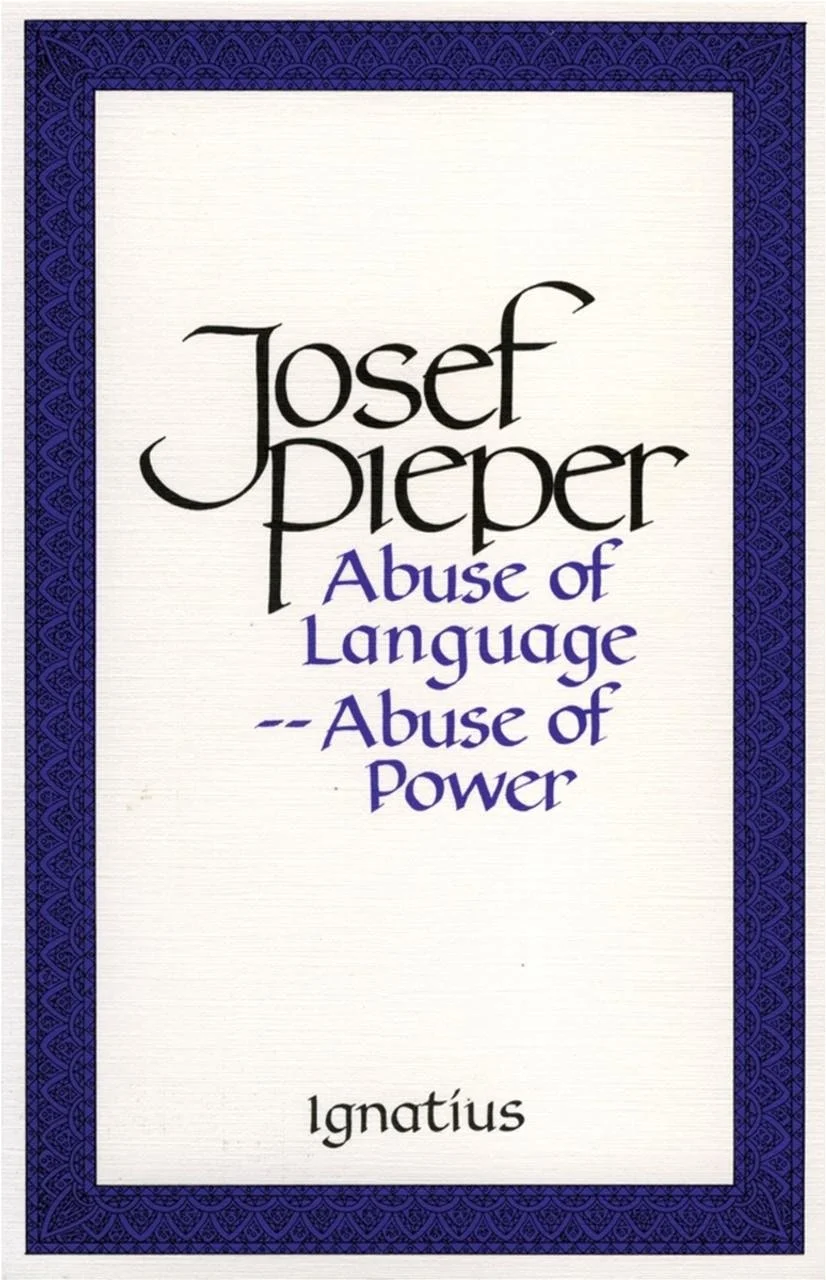
“Language is not simply a means of communication; it is the very medium in which truth is conveyed. To corrupt language is to corrupt the relation of man to reality.”
Josef Pieper
There is a quiet corruption that rarely announces itself as such. It does not arrive with scandal or force, but with softened words, repeated often enough that they begin to feel natural. Josef Pieper saw this clearly in his mid-century work on the abuse of language: when words are bent away from reality, they do not merely mislead, they prepare the ground for the misuse of power.
This insight lands with particular weight in the world of international aid and development, where language is not incidental. It is structural. It shapes incentives, defines success, and ultimately governs how people are treated.
At Water4, we have come to see that many of the persistent failures in aid are not first failures of engineering or funding. They are failures of language.
The First Distortion: When Words Detach from Reality
Pieper warned that language can be turned into an instrument, not for communicating truth, but for producing an effect. In modern terms, it becomes performative rather than descriptive.
Consider the vocabulary that dominates much of the aid sector:
“Beneficiaries”
“Coverage”
“Access”
“Sustainability”
Each of these words has a legitimate meaning. But in practice, they are often detached from the lived reality they are meant to describe.
A village can be counted as having “access to water” because a well was installed. The metric is satisfied. The report is clean. The funding continues.
But if that well is a kilometer away, breaks in six months, no one owns its repair, no system governs its maintenance, and no price signal sustains its function? Then the word “access” has ceased to describe reality. It has become a kind of linguistic placeholder, standing in for something that does not, in fact, exist.
Pieper would say this is not a small error. It is the beginning of disorder. When language no longer corresponds to reality, decision-makers operate in a constructed world. And actions taken within that false world inevitably misfire.
The Second Distortion: When Language Shields Power from Accountability
Once language is untethered, it begins to serve power.
Pieper’s deeper claim is that the abuse of language is never neutral. It is always connected to the abuse of power, because it allows those in authority to act without being held to the truth of outcomes.
In international aid, this often takes the form of what might be called “metric substitution.”
Instead of asking:
Are water systems still functioning five years later?
Are communities able and willing to pay for reliable service?
Is the solution satisfactory with real evidence and reciprocal incentives?
The sector asks:
How many wells were drilled?
How many people were “reached”?
How quickly were funds deployed??
The shift is subtle but decisive. Power, whether held by donors, NGOs, or multilaterals, becomes insulated from the consequences of its own decisions. The language of success is defined upstream, and reality downstream is no longer allowed to speak back.
This is precisely the condition Pieper warned against: a society in which speech no longer serves truth, but instead legitimizes action.
The Third Distortion: The Moral Vocabulary of Aid
Perhaps the most delicate form of linguistic abuse in this space is moral.
Terms like “charity,” “service,” and even “love” can be used in ways that obscure rather than illuminate what is actually happening.
If “charity” becomes a justification for systems that create dependency, it has been emptied of its moral content. If “service” means delivering goods without regard for long-term viability, it may satisfy an immediate impulse while undermining future stability.
The language remains noble. The outcomes do not.
Pieper’s framework presses a harder question: are we using moral language to describe actions, or to excuse them?
We are in an era where intentions are made to matter more than outcomes.
That is a hard heuristic to accept when your life is at stake.
A Different Grammar: From Projects to Solutions
What we have tried to build at Water4 is, in part, a recovery of language that corresponds to reality.
This begins with a shift in grammar:
Not “projects,” but utilities
Not “beneficiaries,” but customers
Not “access,” but service reliability
Not “impact delivered,” but value exchanged
These are not cosmetic changes. They force a different set of questions.
A “project” can end. A utility must endure.
A “beneficiary” receives. A customer chooses.
“Access” can be declared. Reliability must be proven.
“Impact” can be reported. Value must be sustained.
When language is disciplined in this way, it constrains action. It narrows the gap between what is said and what is real. And in doing so, it places limits on power because power can no longer hide behind words that mean less than they claim.
Profit, Properly Understood
One of the more controversial recoveries in this space is the word “profit.”
In much of the aid world, profit is treated as suspect, even corrosive. But this too may reflect an abuse of language.
If profit is understood not as extraction but as the surplus generated by delivering real, sustained value, then it becomes a signal; one that a system is functioning in alignment with human needs.
A water system that generates profit is one that people are willing to pay for, maintain, and rely upon. It is, in a very practical sense, a system that tells the truth.
To reject profit categorically is, in some cases, to reject one of the few mechanisms that forces language and reality to remain aligned.
The Discipline of Truthful Speech
Pieper’s remedy is not complicated, though it is demanding. It is the discipline of truthful speech.
In the context of international development, this means:
Refusing to count what does not endure
Refusing to name as “success” what has not been sustained
Refusing to use moral language where outcomes contradict it
It also means building systems (financial, operational, and institutional) that make it costly to deviate from reality.
This is not merely a technical exercise. It is a moral one.
Because when language is restored to its proper function, when it again describes what is actually there, it becomes possible to act with integrity. And when that happens, power itself is reshaped. It is no longer free to operate in abstraction. It is brought back under the discipline of truth.
Closing
The failures of international aid are often diagnosed in terms of funding gaps, governance challenges, or technical limitations. These are real. But beneath them lies something more foundational.
If Josef Pieper is right, then the renewal of this sector will not begin with more resources or better tools. It will begin with the recovery of language.
Words that mean what they say.
Metrics that reflect what is real.
And systems that are forced, by their very structure, to live within those constraints.
Only then can power be trusted to serve what it claims to serve.
(I want to thank Michael Matheson Miller of the Acton Institute for introducing me to this book this month)