
Bricks and Mortar: Teleology, Virtue, and the Order of Love
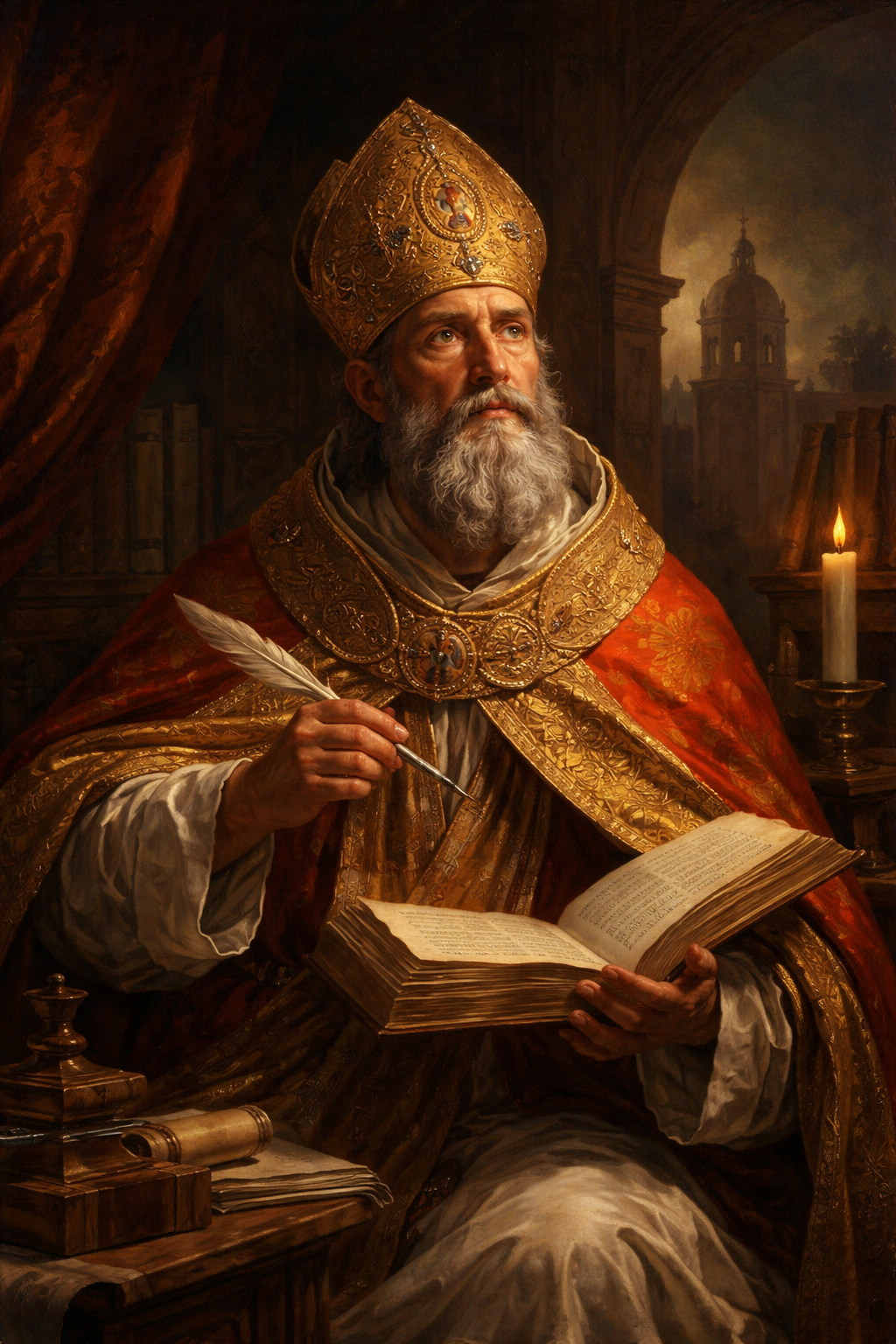
Augustine of Hippo (AI generated)
Five years of reading and practicing classical philosophy brought clarity, but also a limit. Virtue, knowledge, and disciplined habit transform a life, but they do not deliver eternal rest. At the peak of my physical transformation after a decade of illness I found myself on a gurney after being hit cycling by a 50mph SUV. I was living Aristotle’s system to the “T” of telos yet fate had struck me. I had found the power of Socratic logic yet while disorder (of mind, body and society) is ruinous; virtue alone felt like summiting a mountain without glimpsing the city beyond it. Augustine resolves this tension by harmonizing the very traditions that shaped me. These reflections trace that synthesis. May they help you seek the imperishable happiness that does not end.
Bricks and Mortar: Teleology, Virtue, and the Order of Love
Matt Hangen, February 2026
Bricks and Mortar: Teleology, Virtue, and the Order of Love
Matt Hangen
Introduction
The question of the highest good has never been merely theoretical. It determines how one lives, what one pursues, what one sacrifices, and what one refuses to surrender even in the face of loss. Classical philosophy approached this question teleologically: human life is ordered toward an end, and virtue consists in alignment with that end. Across nearly eight centuries, from Plato in the fourth century BC to Augustine in the early fifth century AD, the locus of that ordering progressively deepens. Plato grounds orientation in vision of the transcendent Good; Aristotle locates flourishing in the excellent realization of rational nature within civic life; the Stoics secure stability in disciplined rational assent aligned with universal reason. At each stage, the center of gravity moves inward, from sight, to nature, to judgment, refining the conditions under which the human person may adhere to what is highest.
Yet this interiorization introduces a deeper problem. Seeing the Good does not ensure clinging to it. Living according to nature remains vulnerable to fortune. Rational self-mastery does not guarantee stability of attachment. The tradition increasingly recognizes that orientation alone is insufficient, the decisive question concerns adhesion. What secures the soul in its pursuit of the highest good?
Augustine inherits this trajectory and relocates its center. The decisive principle is love, not in the modern sense of emotional authenticity or private passion, but as the weight that moves the soul toward its ultimate end. Love is not expressive preference; it is objective orientation. The heart does not create its good; it is carried toward what it treats as highest reality. Augustine’s doctrine of ordo amoris therefore presupposes a hierarchy of goods; an ordered reality in which the unchangeable Good alone can bear the full weight of attachment.
This presupposition is crucial. Ordered love requires a prior order of being. Augustine does not abolish classical teleology; he depends upon it. Without metaphysical clarity concerning the Good, without a teleological understanding of human nature, and without the discipline of rational formation, the language of “ordering one’s loves” dissolves into the immediacy of felt intensity. Love becomes a contest of passions rather than a participation in truth. Augustine’s insight functions not as a replacement for Plato, Aristotle, and the Stoics, but as the mortar that binds their structural insights into a coherent vision. If the bricks of teleology are removed, the mortar cannot hold.
The following study traces this development, from vision, to nature, to assent, and finally to love, in order to show that Augustine’s reordering of love is not a departure from classical virtue ethics but its culmination and stabilization. Where teleology is forgotten, love collapses; where the Good is seen, nature disciplined, and judgment trained, love acquires weight. Only within such an ordered framework can the soul rise toward the Good that alone secures rest.
Plato: Eros, Transcendence, and the Limits of Moral Ascent
If orientation is the thread that binds the tradition, Plato (427-347 BC) stands at its metaphysical beginning. For him, the direction of the soul is determined by what it sees as highest. The problem of ethics is therefore inseparable from the problem of vision: to live well is to behold rightly, and to behold rightly is to be drawn upward by eros toward what truly is.
Plato begins with the claim that the human soul is oriented by what it apprehends as highest. Ethics is inseparable from metaphysics: the direction of life depends upon the object of vision. In the Republic, the Form of the Good is presented as the ultimate source of intelligibility and value, that by which all that is just and beautiful becomes knowable and worthy of pursuit (VI 509b–511e, Stephanus). The Good stands beyond the visible realm as the measure of all reality (VI 509b). To live well, therefore, is not primarily to conform to social convention or even to follow instinct, but to behold rightly. The soul becomes what it beholds; its direction is determined by the object it takes to be supremely real.
Yet Plato is not naïve about the instability of such orientation. The soul is not a simple instrument of reason but a composite structure capable of internal conflict. In the tripartite psychology of the Republic (IV 436a–441c), reason (logos), spirit (thumos), and appetite (epithumia) pull in different directions. Appetite may cling to pleasure; spirit may seek honor; reason alone apprehends the Good. Moral disorder is thus a failure of rule, not ignorance alone, but misalignment among the parts of the soul. The problem of ethics is securing the governance of reason so that the whole person moves toward what is truly highest.
Plato therefore places enormous weight on paideia, the gradual formation of desire through disciplined education and habituation. In the Laws (II 653a–654a, Stephanus), education is described as the early training of pleasure and pain so that one learns to love what one ought and hate what one ought. Desire is not suppressed but reshaped. This theme reaches its fullest expression in the Symposium, where eros is depicted as an ascending movement from attachment to particular bodies toward contemplation of Beauty itself (210a–212a, Stephanus). The solution to misalignment is not repression but redirection: eros must be taught to climb.
Plato’s account thus assumes that orientation can be secured through right vision and right formation. Once reason apprehends the Good and the soul is properly educated, harmony follows. Psychic conflict is intelligible and, in principle, resolvable. The soul may be disordered, but it is capable of reordering through ascent. Sight, supported by formation, governs love.
Yet this confidence carries an unresolved tension. It presumes that once the soul sees clearly and is rightly formed, it will ultimately align itself with what it knows to be highest. But what if vision does not secure attachment? What if the soul can behold the Good and still fail to cling to it? Plato establishes transcendence and provides an account of misalignment, yet the question remains whether seeing and formation alone are sufficient to secure rest. With Plato, the principle of orientation is established in vision; whether it is finally secured remains the burden of the tradition that follows.
Aristotle: Teleology Within History and the Vulnerability of Flourishing
Aristotle (384-322 BC), Plato’s student, shifts orientation from vision to nature. The self is not primarily directed by what it sees, but by what it is. The human good is the activity of the soul in accordance with virtue (Nicomachean Ethics I.7), unfolding across a complete life.
Plato’s ascent left unresolved the question of how transcendence is embodied within ordinary life. Aristotle inherits the language of purpose but relocates its center of gravity.
The soul is not directed primarily by what it contemplates beyond the world, but by what it is within the world. Orientation shifts from vision of the Good to the realization of a natural end. The virtues do not redirect eros upward but actualize rational form within embodied life. The soul becomes what its nature perfects.
Aristotle defines the human good as eudaimonia, the activity of the soul in accordance with virtue over a complete life (NE I.7, 1098a16–18). Because the human being is a rational and political animal, this flourishing must be enacted within the polis, supported by law, friendship, and civic order (Politics I.2, 1252b27–30). Aristotle therefore locates the telos within history, not as a concession to fortune, but as a consequence of his anthropology.
“For one swallow does not make a summer, nor does one day; and so too one day, or a short time, does not make a man blessed and happy.” (NE I.7, 1098a18–20)
Aristotle’s ultimate telos is not merely biological but teleological through biology: human flourishing consists in the excellent actualization of rational nature across a complete life. The virtues make a human being magnificent in the same way that speed and strength make a horse excellent; not by adding something extrinsic, but by perfecting what the thing already is.
Yet because this perfection remains embodied, temporal, and vulnerable to fortune, Aristotle concedes that happiness is not invulnerable. Because orientation is embedded in history, flourishing remains exposed to contingency. The self’s good depends upon the integrity of the life it lives. Severe reversals late in life can obscure flourishing, revealing a structural fragility in any telos fixed entirely within history (NE I.10–11).
Aristotle’s ultimate telos, then, is the excellent actualization of rational nature within embodied, civic, and temporal life (much like a magnificent horse fully expresses horse-nature throughout its life) so that the virtues produce genuine flourishing here and now.
The Stoics: Rational Insulation and the Insulated Telos
Aristotle began from the observation that human beings are complex, embodied, socially embedded creatures whose excellences unfold over time. His ethics is therefore developmental, plural, and narrative. The virtues correspond to distinct dimensions of human life: fear, desire, action, judgment, friendship. Excellence consists in their gradual integration through habituation, practical wisdom, and participation in the polis.
Flourishing (eudaimonia) is something one becomes across a complete life, and partial excellence is real even if imperfect. The cost of this realism is exposure: happiness remains vulnerable to fortune, misfortune, and tragic loss.
The Stoics radicalize orientation by relocating it entirely within rational control. The self is oriented not by what it sees nor by what it is socially embedded in, but by what it can govern. The orientation of virtue must be secured where fortune cannot reach, within the domain of rational assent.
The Stoics begin from this anxiety, the moral scandal of vulnerability itself. They judge Aristotle’s account to concede too much to luck. If happiness can be damaged by what lies beyond our control, then happiness is not fully rational (because what is fully rational is not at the mercy of fate). In response, the Stoics radically simplify the moral architecture. Virtue is no longer many and developmental but one and absolute: right reason in harmony with nature. External goods are reclassified as “indifferents,” and the ethical task is no longer the integration of embodied life but the purification of judgment.
Moral progress exists, but virtue itself admits no degrees: one either assents correctly or not. The Stoic ideal human (the sage) is therefore not a richly formed character across domains but an internally unified will immune to circumstance.
Aristotle’s virtuous person is a friend, a citizen, a parent, a deliberator: someone whose excellence is inseparable from concrete relationships and social practices. The Stoic sage, by contrast, is excellent by detachment. His freedom is real, but it is purchased by narrowing the range of goods to which the soul is exposed. Not antisocial, but highly attuned to the reality that the pursuit of the social life is ripe with false paths and divertive traps. The richness of Aristotle’s narrative of becoming is traded for the security of Stoic invulnerability based on the hard knocks of attempting it within the Greco-Roman political life.
Orientation is secured through the distinction between what is “up to us” and what is not (Epictetus, Enchiridion 1). The self becomes invulnerable by withdrawing final value from externals.
The Stoics do not abandon social or political life; figures like Seneca and Marcus Aurelius participate in it at the highest levels. What they abandon is Aristotle’s willingness to let the success or failure of that life bear ontological weight in determining human flourishing. Aristotle’s narrative of becoming permits tragedy as a real wound to happiness; Stoicism, forged in the hard knocks of Greco-Roman political life (where despite one’s virtue you could be sent into exile, have your goods confiscated, or be assassinated) relocates the good entirely within rational assent in order to secure invulnerability. Engagement remains, but ontological weight is withdrawn. The sage participates fully while refusing to let outcomes determine the state of the soul. The richness of Aristotle’s account is thus not rejected through withdrawal, but through a deliberate insulation of the soul from the moral volatility of history.
The Crisis of Attachment: Vision, Nature, and the Limits of Stability
By the close of the classical arc, the problem of the highest good has been progressively clarified and interiorized. Plato locates the measure of life in vision of the transcendent Good; Aristotle grounds flourishing in the actualization of rational nature across a complete life; the Stoics secure stability in disciplined assent aligned with universal reason. At each stage, orientation deepens: the soul sees more clearly, understands its design more fully, and governs its judgments more rigorously. The architecture of virtue becomes increasingly refined.
Yet refinement exposes a deeper instability. The tradition has clarified what the Good is, how it corresponds to human nature, and how the will may align itself with it. What remains less certain is what secures enduring adhesion. Seeing the Good does not guarantee clinging to it. Living according to nature does not eliminate exposure to temporal fracture. Even rational discipline, though capable of insulating the highest good from fortune, presumes that assent itself remains steady and unified.
The question now presses beneath epistemology and ethics: what binds the self irrevocably to what it judges highest? Plato trusts that philosophical formation can harmonize the soul. Aristotle trusts that habituated virtue can stabilize character across a lifetime. The Stoics trust that disciplined assent can render the good invulnerable. Each response strengthens the architecture of moral life. Yet each presupposes that the self, once rightly oriented, can sustain its attachment without collapse.
Here the tension becomes structural rather than circumstantial. The difficulty is no longer ignorance, nor misfortune, nor lack of discipline. It is the fragility of attachment itself. The soul may apprehend the Good, embody virtue, and master its judgments, and yet remain internally susceptible to division, pride, or eventual dissolution. The highest good has been secured conceptually and psychologically; it has not yet been secured ontologically.
Even the Stoic confidence that what truly matters cannot be taken anticipates a deeper horizon. If virtue alone constitutes the good, then death cannot deprive the sage of what is ultimate. Yet this invulnerability rests upon interior mastery and reaches its limit at mortality. It secures freedom from loss, but it does not yet explain rest beyond loss. Stability has been achieved within history; permanence has not yet been grounded beyond it. There is a greater prize, eternal rest, only revealed in Christ.
Thus the crisis of attachment emerges not as a failure of classical philosophy, but as its culmination. The tradition has supplied vision, teleology, and disciplined assent. What it has not yet supplied is the principle that fixes the heart in permanent communion with its end. Orientation without adhesion remains unstable. The soul may ascend, may flourish, may master itself and still fail to rest. The missing element is not further knowledge, nor stricter discipline, but the weight that binds the will irrevocably to what is highest. It is here that love emerges--not as sentiment, but as moral gravity--the force capable of binding the will to what it judges highest.
The instability Augustine names was not absent from the classical tradition; it was present as a recurring pressure that no single account resolved. Plato recognized the soul’s internal conflict and the difficulty of securing harmony even after illumination. Aristotle acknowledged that flourishing unfolds within conditions vulnerable to reversal, leaving the highest human good exposed to contingency. The Stoics sought to answer this vulnerability by relocating the good within disciplined assent, yet their very emphasis on interior control reveals an anxiety about the durability of attachment. Each tradition circles the same problem from a different angle: how the soul remains bound to what it judges highest across time, suffering, and change. What Augustine contributes is not the discovery of this tension but its diagnosis at the level of love. The will fails not merely because it lacks knowledge or discipline, but because it is carried by disordered attachment. The question of teleology therefore becomes inseparable from the question of adhesion.
Augustine: Creation, Love, and the Eschatological Reordering of the Telos
The crisis demands a principle capable not merely of orienting the self, but of securing its adhesion to the highest good.
Augustine (354–430 AD) answers this crisis by relocating the telos itself. The ultimate end is not realized within history, nor secured through ascent, nor protected by rational insulation. It is found only in the unchangeable source of being: God. “You have made us for yourself, and our heart is restless until it rests in you” (Confessions I.1). The restlessness of the heart is not failure but design; it is the mark of creation. We are made for something beyond mutable goods, and until love reaches its proper object, it remains unsettled.
This relocation begins with creation ex nihilo. The Good is not merely the highest intelligible Form but the living source from whom all being flows. Creatures do not climb toward a higher rung in an ontological ladder; they depend at every moment upon the One who sustains their being. The instability that haunted Platonic ascent and Aristotelian flourishing is therefore not accidental. Finite goods are good, but they are not ultimate. They cannot bear the full weight of love. When the heart treats them as ultimate, it fractures.
Augustine names this fracture not as ignorance alone, nor as misrule among psychic parts, but as a disorder of love. In Confessions VIII, the will both commands and resists itself; velle and nolle operating within the same person. One may see the good and yet fail to cling to it. The problem is not simply that appetite rebels against reason, but that the will itself is divided. Illumination does not guarantee adhesion. The soul can ascend intellectually and remain unstable in love.
Here Augustine introduces his central moral grammar: ordo amoris. “My weight is my love” (Confessions XIII.9.10). Love is gravity. It carries the soul toward what it treats as ultimate. The question is not whether we love, but whether we love in the right order. Disordered love (cupiditas) fastens ultimate weight upon mutable goods. Baptizing and fulfilling the Stoic aim, rightly ordered love (caritas) adheres to the Good that cannot be lost. The will cannot heal itself merely by discipline or education; it must be reoriented. Grace restores what ascent alone cannot secure.
This reordering of love reshapes political life as well. Augustine’s doctrine of the two cities makes clear that history is structured not by rival constitutions but by rival loves: “Two loves have made two cities: the love of God even to the contempt of self, and the love of self even to the contempt of God” (City of God XIV.28). The true common good is not secured by civic excellence alone but by shared orientation toward the highest good. The earthly city may achieve relative peace, but it cannot achieve final rest, because its love remains divided.
Peace itself is redefined. It is not detachment from goods, nor the mere absence of conflict. It is tranquillitas ordinis; the tranquility of order (City of God XIX.13). Peace arises when love rests where it ought. Sacrifice, in this light, is not ritual performance but the offering of the self in rightly ordered love (City of God X.6). The true sacrifice is a life directed toward God, a will aligned with its source. The culmination of teleology is therefore not simply contemplative vision, but stable communion; love at rest in what cannot perish.
Augustine does not discard ascent; he secures it. He does not abolish eros; he heals it. The soul still moves upward, but its stability no longer depends upon clarity of sight alone or the strength of philosophical discipline. It depends upon the reordering of love by grace. The telos is relocated beyond history, yet history becomes pilgrimage; the journey of a people whose hearts are being reordered toward a good that alone can bear their weight.
Plato and Augustine Revisited: Ascent, Attachment, and the Healing of Love
If the classical tradition progressively interiorizes the principle of orientation, Plato and Augustine stand in closest proximity at the level of transcendence. Both refuse to locate the highest good within mutable civic life. Both insist that the soul is directed toward what lies beyond flux. In the Republic, the Form of the Good is the ultimate source of intelligibility and value (VI 509b–511e, Stephanus); in the Symposium, eros ascends from attachment to perishable beauties toward contemplation of Beauty itself (210a–212a). The soul’s motion is upward. It longs for what most fully is.
At this level, Augustine appears deeply continuous with Plato. He too affirms that the heart cannot rest in finite goods and that its true object lies beyond temporal instability. Yet the metaphysical grammar subtly shifts. For Plato, ascent culminates in contemplative participation in eternal Forms; realities that ground being and intelligibility. For Augustine, the Good is not merely the highest intelligible principle but the living source of being itself. Love is not simply upward participation but ontological dependence. The soul does not merely climb toward what is higher; it is carried by its love toward what it treats as ultimate. Participation becomes communion, and vision yields to rest.
The divergence becomes sharper at the psychological level. Plato’s tripartite soul (Rep. IV 436a–441c) diagnoses disorder as misrule among distinct faculties. Appetite may resist reason; spirit may ally with one against the other. Yet this conflict remains intelligible and, in principle, resolvable through paideia. Proper formation trains desire to love what reason recognizes as highest. The soul’s ascent is difficult but coherent. Once reason governs and eros is redirected, harmony follows.
Augustine, however, discovers a fracture that persists beyond pedagogy. In Confessions VIII, the will both commands and resists itself; velle and nolle operating within the same subject. The problem is not simply that appetite rebels against reason, but that willing itself is internally divided. One may see the good clearly and yet fail to cling to it. Illumination does not secure adhesion. Here the optimism implicit in Platonic ascent encounters its limit. The soul can ascend intellectually and remain volitionally unstable.
For this reason, it is insufficient to say that Augustine replaces eros with agapē. The more precise contrast is between cupiditas and caritas. Augustine does not abolish desire’s upward dynamism; he radicalizes its instability. Disordered love fastens ultimate weight upon mutable goods. Rightly ordered love adheres to the Good that cannot be lost. The issue is not whether desire ascends, but whether it is healed. Where Plato envisions ascent through disciplined vision and formation, Augustine insists that the deepest disorder lies in attachment itself. Love must be restored, not merely redirected.
Thus, Augustine both fulfills and unsettles Plato. He affirms transcendence, ascent, and the insufficiency of finite goods. Yet he denies that vision and formation alone can secure rest. The Good is not merely that which is seen, but that in which the soul must abide. The culmination of teleology is not simply contemplative participation, but stable communion grounded in rightly ordered love. In this way, Augustine does not discard eros; he reconstitutes it. The upward motion remains, but its security depends not on clarity of sight alone, nor on disciplined ascent, but on the healing of love in relation to the source of being itself.
Conclusion
The classical tradition does not culminate in the abandonment of teleology but in its interior completion. Plato teaches that the soul must see the Good; Aristotle that it must live according to its nature; the Stoics that it must discipline its assent so that what is highest cannot be taken by fortune. Each stage refines the conditions of orientation. Yet orientation alone does not secure adhesion. The decisive question becomes not merely what one apprehends as highest, nor what one is by design, nor what lies within rational control, but what one loves with ultimate weight.
Augustine does not dissolve the earlier achievements of this tradition; he binds them together. Love is the mortar that secures the structure; the interior gravity that fixes the soul to its proper end. But mortar without bricks cannot stand. If the metaphysical clarity of the Good is lost, if the teleological understanding of human nature erodes, if the discipline of rational formation is abandoned, then the language of ordered love collapses into the force of present passion. Detached from teleology, love becomes expressive intensity rather than participation in truth. The architecture of virtue fragments not because love is unimportant, but because it has been severed from the order it is meant to bind.
To recover Augustine’s ordo amoris is therefore not merely to exhort believers to love more deeply; it is to retrieve the philosophical framework that renders such love intelligible. Ordered love presupposes ordered reality. The ascent of the soul depends upon the weight of a true telos; discovered through inquiry, embodied in disciplined practice, and sustained by grace. Where vision, nature, and assent are restored, love acquires density; where they are neglected, it becomes weightless and unstable.
Augustine’s final word is not endless striving but rest; not self-assertion but communion with the Good that cannot be lost. A communion that cannot be anticipated or recognized outside the breach of the Ultimate into material as Love in the form of Christ. Rest does not negate ascent; it fulfills it. The soul rises not by passion alone, but by the gravity of rightly ordered love anchored in the source of being itself.
References
Aristotle. (1985). Nicomachean Ethics (T. Irwin, Trans.). Hackett.
Aristotle. (1984). Politics (C. D. C. Reeve, Trans.). Hackett.
Plato. (1997). Complete Works (J. M. Cooper & D. S. Hutchinson, Eds.). Hackett.
Augustine. (2003). City of God (H. Bettenson, Trans.). Penguin.
Augustine. (2006). Confessions (H. Chadwick, Trans.). Oxford.
Epictetus. (1995). Enchiridion (E. Carter, Trans.). Penguin.
Seneca. (2015). Letters on Ethics (M. Graver & A. Long, Trans.). University of Chicago Press.
Marcus Aurelius. (2002). Meditations (G. Hays, Trans.). Modern Library.